I am an M.S. graduate in Computer Science and Engineering from National Chung Hsing University, Taiwan, advised by Prof. Pi-Chung Wang. My research focuses on learning-guided planning: using learned policies and value functions to make explicit search effective in large, state-dependent action spaces. I use mobile charging and resource-allocation problems as structured testbeds for studying planning under computational budgets, hierarchical decisions, and generalization across problem instances.
My current research is moving toward coordinated multi-agent planning. For my PhD, I want to study how agents can learn internal representations and world models for abstraction, reasoning about possible futures, and long-horizon planning under uncertainty. My broader goal is to develop agents that use these capabilities flexibly across tasks. I am applying to PhD programs for Fall 2027.
I am extending LP-BTS to coordinated multi-agent planning, using multi-charger scheduling as a structured testbed. The central question is how learned proposal policies and structured action representations can make search over interacting agents’ decisions tractable. Current work focuses on representing compatible joint actions, reducing the candidate space, and allocating limited search budgets to evaluate future interactions.
02
arXiv preprint · Sep. 2026
Learning-Guided Planning in Large Dynamic Action Spaces: Budgeted Tree Search for One-to-Many Mobile Charging
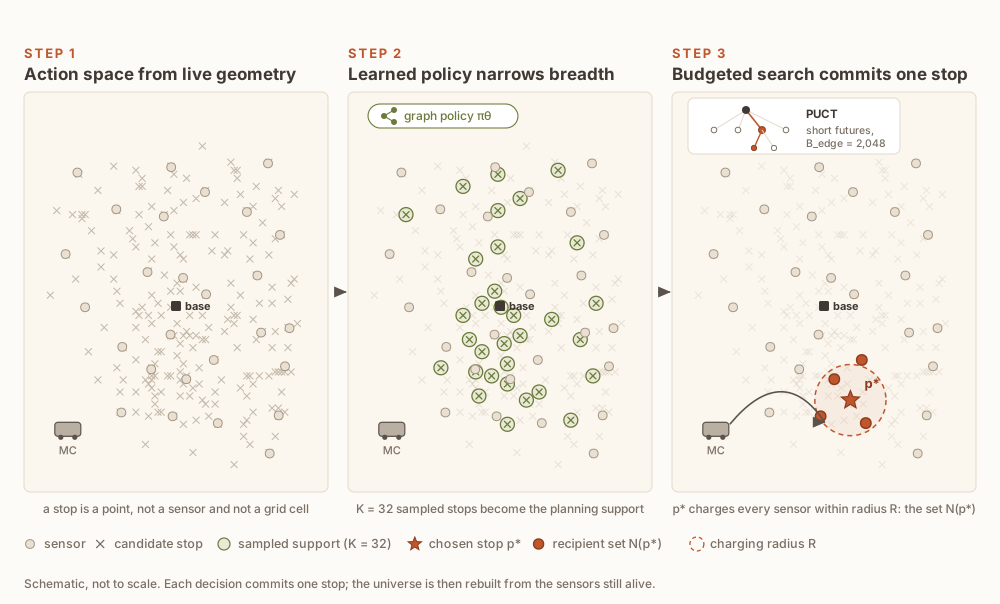
LP-BTS studies planning when the available actions are numerous, structured, and rebuilt as the state changes. A graph proposal policy first scores candidate stops and narrows search to a small set of candidate actions. A learned value critic estimates the promise of partial plans, and budgeted PUCT—a tree-search rule with a fixed simulation budget—compares simulated action sequences before an action is chosen. Mobile charging is the current testbed for the broader question: how can learning focus limited computation while explicit search evaluates future consequences?
Matched RL comparison: against a trained, source-derived deep reinforcement learning baseline, LP-BTS improves survival by 12.29 percentage points and alive-AUC by 4.60 percentage points, while reducing travel distance by 53.9% (53,015 m vs. 114,933 m).Sealed 30-scenario evaluation. The trained comparator is reconstructed from its source method under the paper’s common-physics protocol.
One LP-BTS decision, schematic. Candidate stops are recomputed from the live sensor geometry, the learned policy samples a small planning support, and budgeted search commits a single stop. Full definitions in the preprint ↗
HQARRF: Hierarchical Q-learning and Force-aware Routing for Multi-Charger Scheduling
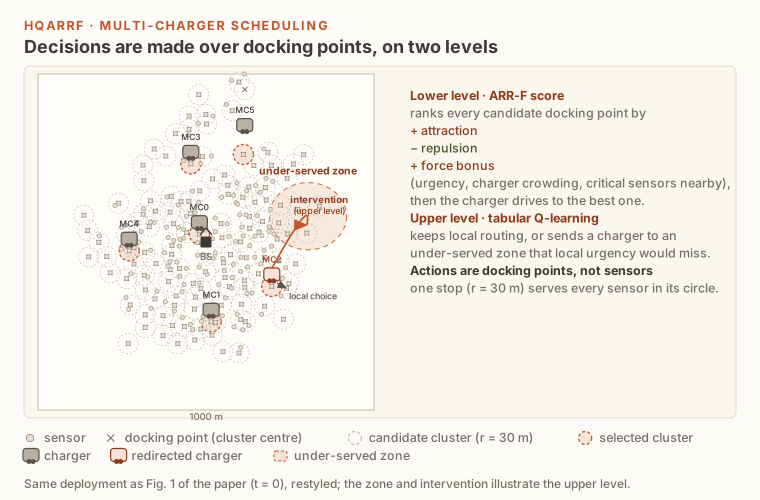
HQARRF uses multi-charger scheduling as a testbed for hierarchical coordination. A gated Q-learning upper level redirects service toward high-risk, under-served regions, while a force-aware lower-level ranker handles local routing and charging decisions—separating strategic allocation from fast structured action selection.
Robustness across 27 settings: HQARRF achieves the highest mean survival in 26 of 27 evaluated parameter settings. Across the grid, it improves survival by an average of 20.7 percentage points over the mean of five baselines and by an average of 9.2 percentage points over the strongest baseline at each setting.Averages are computed across the paper’s 27-parameter evaluation grid.
The t = 0 deployment of Fig. 1 of the paper, restyled for the site. Decisions are made over docking points: the lower level ranks them with the ARR-F score; the upper level can redirect a charger to an under-served zone.
I am the first author of all works listed below. Status labels distinguish public preprints, accepted oral/poster presentations, and previously presented work. One-page conference abstracts are linked where available; full manuscripts are available on request where permitted.
PreprintarXiv · Sep. 2026
“Learning-Guided Planning in Large Dynamic Action Spaces: Budgeted Tree Search for One-to-Many Mobile Charging”
One LP-BTS decision: a learned graph policy narrows a dynamic candidate set, then budgeted search compares simulated action sequences before committing a charging stop.
Tractable search over interacting decisions, using multi-charger scheduling as the current testbed.
05PhD directionLearning internal models for planning
Toward learned world models, state/action abstractions, and long-horizon decision-making under uncertainty.
About
Research perspective
Completed work. LP-BTS asks how a planner can reason ahead when its available actions are numerous and change with the state. Its graph policy identifies promising candidates, its learned value critic evaluates partial futures, and budgeted search compares those futures before commitment. This work examines how learned policies and value estimates can focus limited search on promising actions in large, state-dependent action spaces.
Ongoing work. I am extending this framework toward coordinated multi-agent planning with several chargers. The immediate questions are how to represent compatible choices consistently, reduce the number of choices worth searching, and allocate a limited lookahead budget over their future interactions.
PhD direction. I want to study how agents can learn internal representations and world models that support abstraction, reasoning about possible futures, and long-horizon decision-making. I am particularly interested in how these learned models can support hierarchical planning: decomposing goals, evaluating alternative courses of action, and revising plans as new information becomes available. My longer-term aim is to develop agents that can use these capabilities flexibly across tasks and coordinate with other agents under uncertainty.